You've tested your product. You have a protein number. Now what?
For many brands, that number goes straight to the Nutrition Facts panel. But the path from lab result to compliant label claim is more nuanced than it appears, and the gap between total protein and what you're actually permitted to claim is important to understand.
This article walks through exactly how protein test results translate to % Daily Value, what thresholds determine claim eligibility, and where brands most commonly get this wrong.
Why Total Protein Is Not the Same as Your %DV
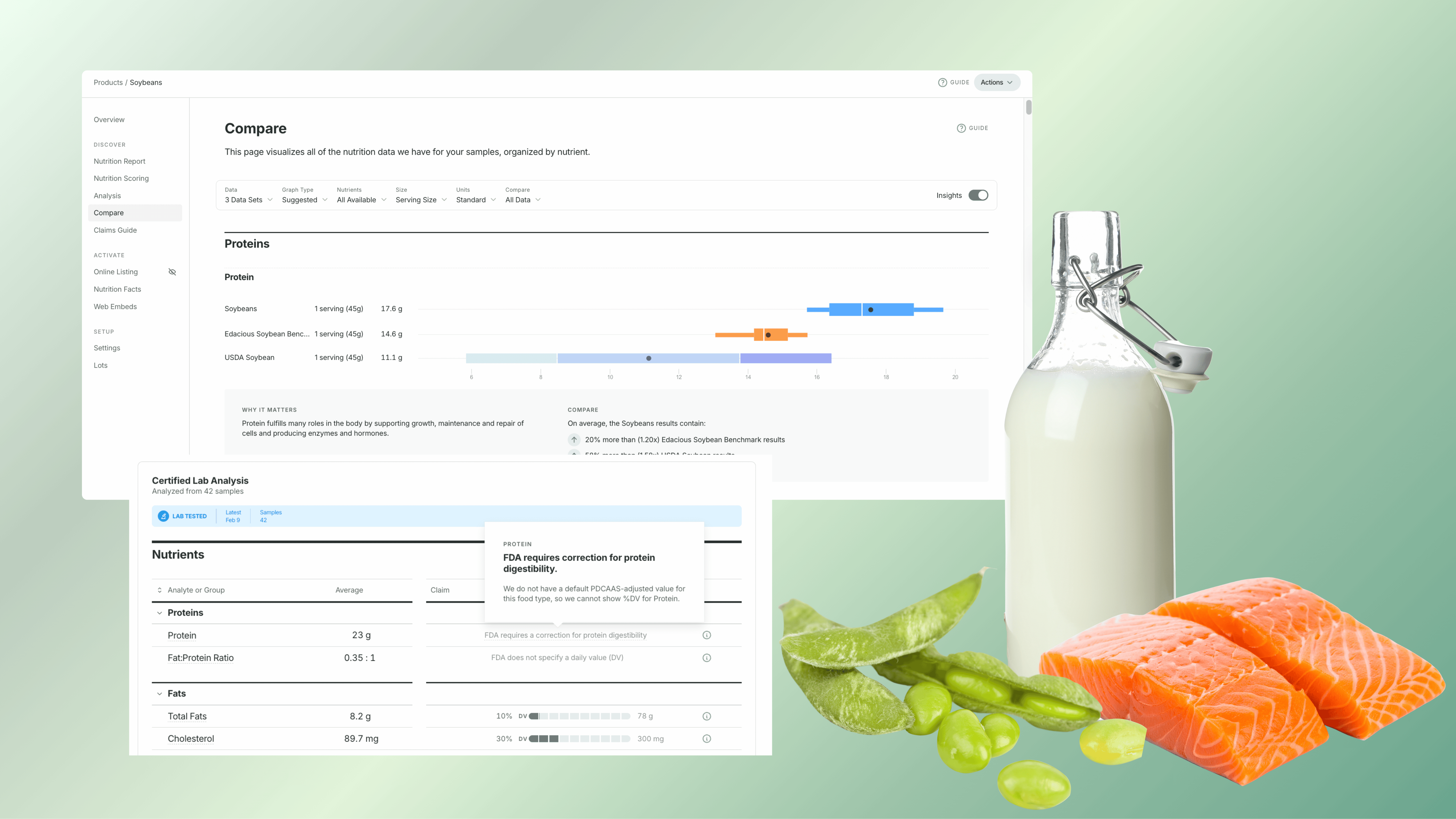
When you receive protein test results, you're typically seeing total protein measured in grams per serving. That number is what typically appears in the main protein row on the Nutrition Facts panel. That is unless the product under the label plans to make any claims around source eligibility.
This distinction matters more than most brands realize. While the FDA does not require the protein %DV to appear on every label, when it does appear, the calculation must use PDCAAS-adjusted protein values. And when you make a protein content claim such as "good source of protein," "high in protein," or any equivalent, that claim must also be based on the quality-adjusted value.
% Daily Value for protein is calculated differently from total protein. Under FDA regulations, protein %DV must be based on quality-adjusted protein, which is calculated as total protein multiplied by the food's PDCAAS score.
How Protein %DV Is Actually Calculated
Let’s put this into a real-world example. Beans might have 6 grams of total protein and have a PDCAAS value of 0.60. Meaning it has 3.6 grams of quality-adjusted protein.
Protein %DV is calculated as: Quality-Adjusted Protein (g) ÷ 50 g × 100 = % Daily Value. The reference daily intake (RDI) for protein is 50 grams for adults and children four years and older. Using the example above: 3.6 ÷ 50 × 100 = 7.2% DV.
So, the %DV and any claims must reflect that 3.6g, not the 6g. Without the appropriate adjustments, a brand might overestimate the %DV of protein by 67%.
FDA Protein Claim Thresholds: Good Source vs. Excellent Source
% DV covers the back of pack, but let’s now tackle the appropriate claims that those adjustments can unlock on front-of-pack.
Source content claims across any nutrient must meet certain thresholds (10% or more for good source claims and 20% or more for rich source claims) for a brand to market those claims across the product.
FDA protein content claims follow the same established thresholds, but importantly, are based on quality-adjusted protein, not total protein:
- "Good source of protein" requires at least 10% DV per serving — meaning at least 5 grams of quality-adjusted protein per serving.
- "Excellent source of protein" (or "high in protein") requires at least 20% DV per serving — meaning at least 10 grams of quality-adjusted protein per serving.
A product with 8 grams of total protein and a PDCAAS of 0.55, has 4.4 grams of quality-adjusted protein, falling below the "good source" threshold despite having what looks like a reasonable gram count.
The example above shows a common point of miscalculation and risk. Brands see a strong total protein number, assume claim eligibility, and build marketing around a "good source" designation that the quality-adjusted data does not support.
Protein Claims, Regulatory Risk, and Private Litigation
Protein claims have been the subject of growing regulatory and litigation attention. Several high-profile class action suits have targeted brands whose protein %DV and content claims were not calculated using PDCAAS-adjusted methodology. The argument in these cases is straightforward: if the label says "good source of protein" but the quality-adjusted protein falls below the threshold, the claim is misleading.
This doesn't mean every brand with a protein claim is at risk. It means that brands whose claims are grounded in verified, documented, methodology-sound data are in a meaningfully better position than those whose claims are grounded in total protein grams alone.
Defensible claims require defensible methodology, and both require verified primary data.
A Protein Label Compliance Checklist
Before finalizing a protein claim or %DV on a label, the following questions should have clear answers:
- Does the label protein %DV reflect PDCAAS-adjusted protein, not total protein?
- Is the PDCAAS value used either from validated literature, direct testing, or a documented conservative proxy?
- Does the quality-adjusted protein value meet the relevant threshold for the claim being made (10% DV for "good source," 20% DV for "excellent source")?
- Is the methodology documented in a way that can be produced if the claim is challenged?
If any of these answers is unclear, the claim carries more risk than it needs to.
What This Series Has Built
Across these four posts, the Protein Quality Series has traced the full arc from concept to compliance:
Total protein measures quantity. PDCAAS measures quality. Quality-adjusted protein determines what you can claim. And the methodology behind that calculation is what makes the claim defensible.
That arc — from measurement to interpretation to action — is exactly what verified nutrition data is designed to support. It's also exactly what we do at Edacious. If this series raised questions about your own products, let us help you navigate the protein quality of your food.
The Protein Quality Series examines how protein quality is measured in real food — beyond total grams and marketing claims. We explore amino acid balance, digestibility, PDCAAS, and regulatory thresholds to clarify how usable protein is calculated, qualified, and communicated. Because when it comes to protein, quantity alone is not the full story.