


From the Lab—Science & Data Insight
Does Adding Organ Blends to Ground Beef Boost Nutrient Density?

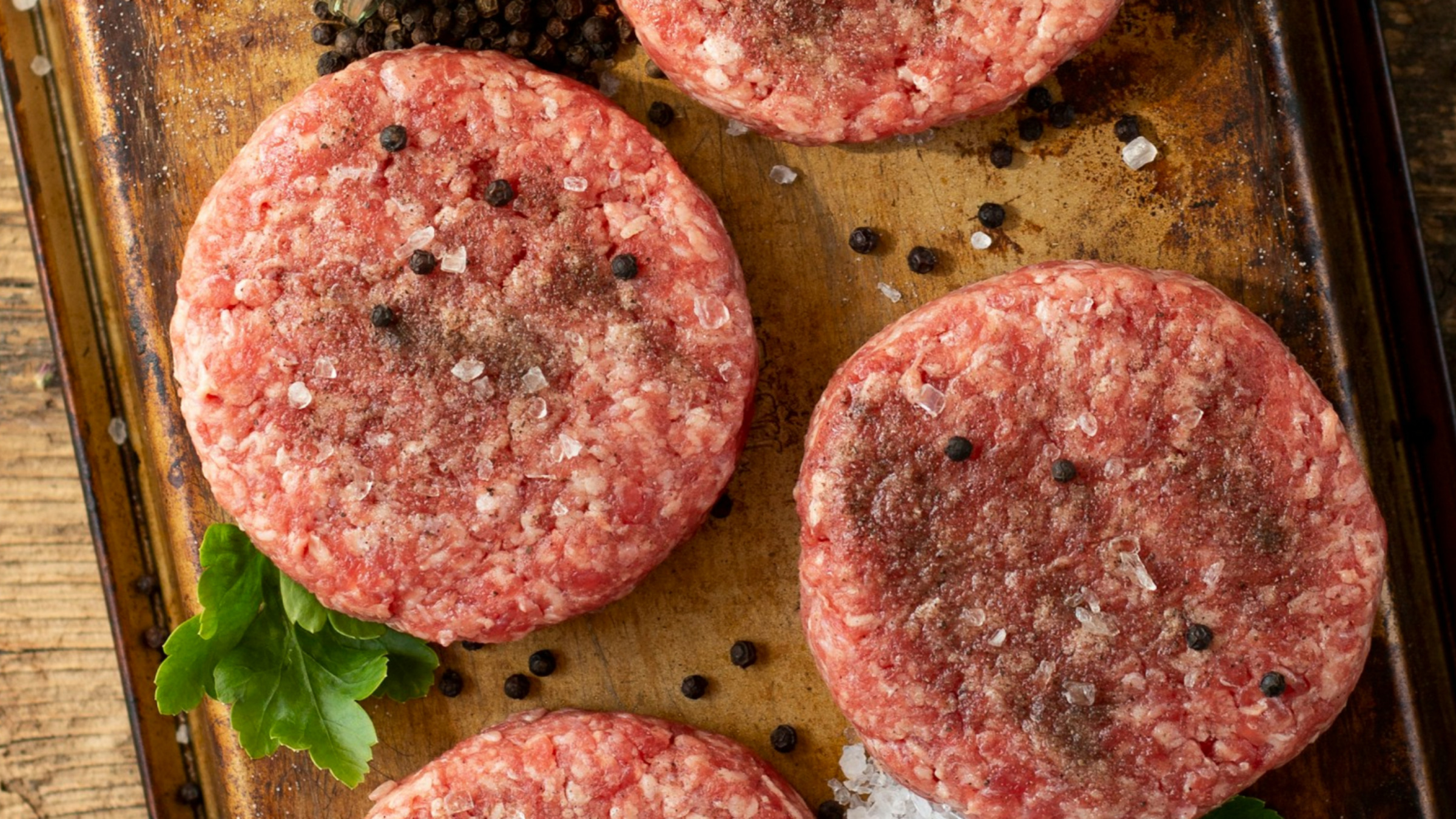
A growing number of brands are building "ancestral" or nose-to-tail-inspired ground meat blends that reintroduce organ meat in small, palatable percentages, positioning the product around nutrient density rather than around organ meat itself.
The name is a nod to how animals used to be processed. Earlier generations of butchers and home cooks made a point of using as much of the animal as possible, where modern meat production is built around a smaller set of popular, profitable cuts, often leaving organs and other parts underused. There is a sustainability argument here too: folding organ meat back into ground product means less of the animal goes to waste, worth noting for beef in particular, one of the higher-footprint proteins per pound.
But does swapping a small percentage of heart and liver into ground beef actually change the nutrient profile, and by enough to matter? According to our lab data, yes, in specific vitamins and minerals, and in several cases by enough to move a product across an FDA nutrient content claim threshold. Here is what we measured, how much it changed, and why it matters.
These figures come from a locked Edacious dataset of 327 lab-tested samples: 274 standard ground beef and 53 organ-inclusive (offal) blends, spanning 54 standard products across 28 companies and 10 blend products across 7 companies, tested to ISO-17025 standards between February 2025 and July 2026. All values are per 4 oz (112 g) serving, and %DV reflects the FDA Daily Value. Sample sizes vary by nutrient; where a nutrient rests on a notably small sample, we say so.
What Nutrients Change When You Add Organ Meat to Ground Beef
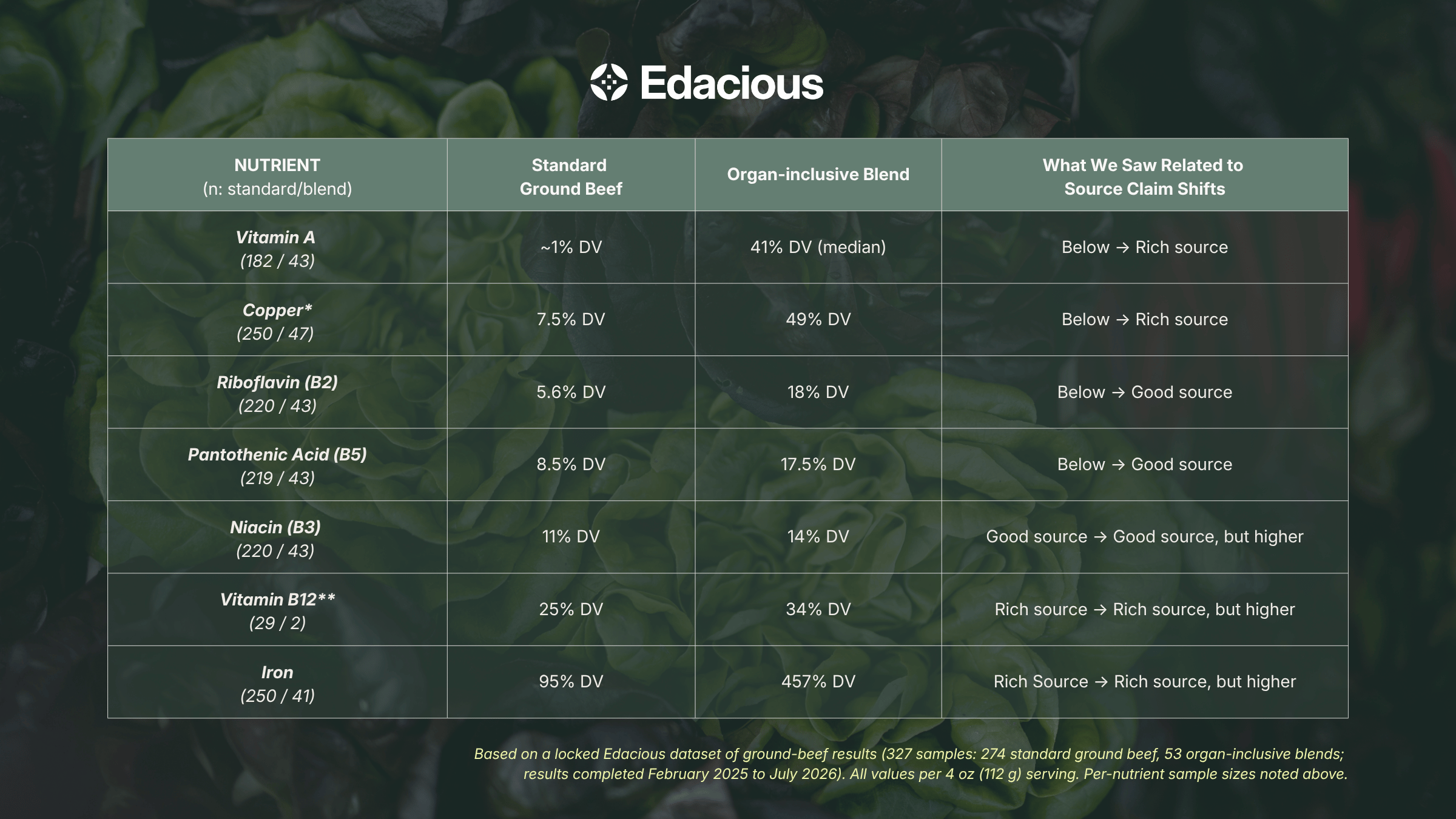
- *Copper is sometimes flagged as a nutrient to watch, but that concern is tied to genetic conditions or to high-dose supplementation, not to food-based copper intake in healthy adults. The U.S. tolerable upper intake level is 10 mg/day; even under the stricter EU limit of 5 mg/day, one serving of the blends tested (0.45 mg) is about 9% of that limit.
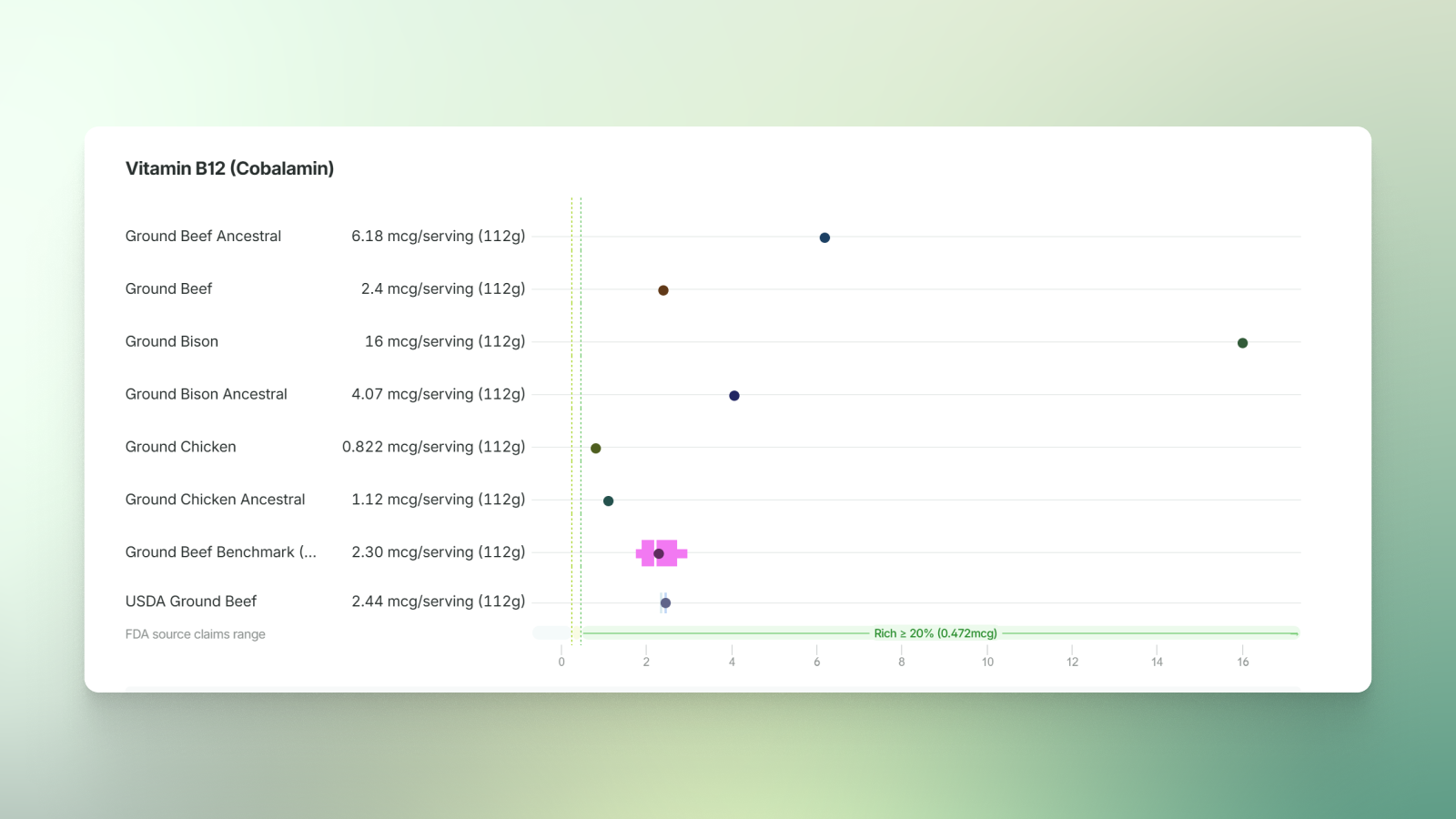
- **Vitamin B12 rests on a small sample (29 standard, 6 blend), so treat this one as indicative rather than settled. Notably, standard ground beef is already far past the "rich in" threshold before any blending happens.
Vitamin A Sees the Biggest Increase in Organ-Inclusive Ground Beef
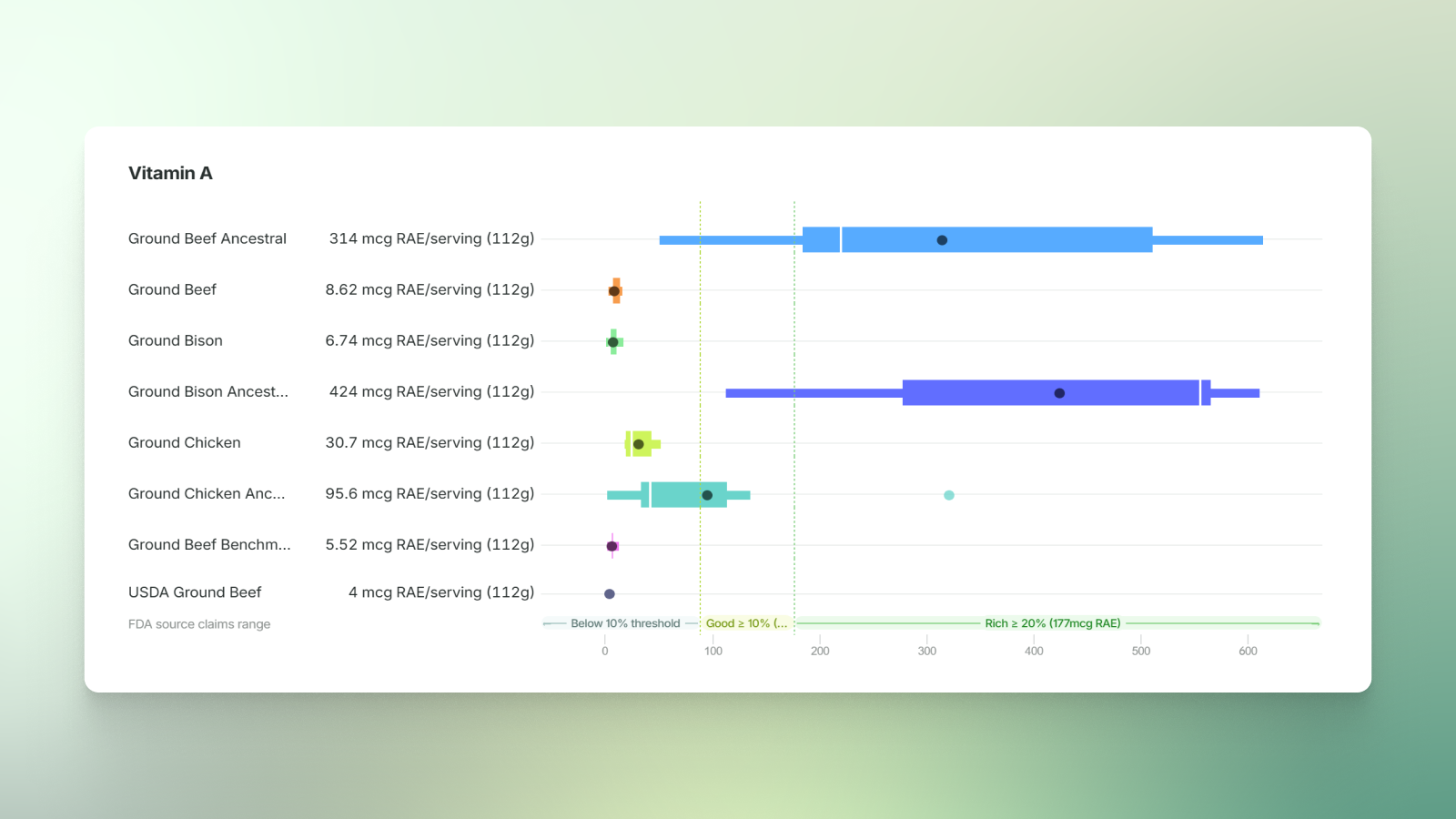
Vitamin A supports vision, skin and gut-lining health, and immune function, and it's a nutrient the U.S. Dietary Guidelines flag as under-consumed. Standard ground beef supplies almost none. We're leading with the median rather than the mean here (the mean would show an even larger jump) because a handful of high-liver samples pull the average up; the honest framing is "from near-zero to a genuinely useful amount."
Riboflavin and Pantothenic Acid Cross Into "Good Source" Territory
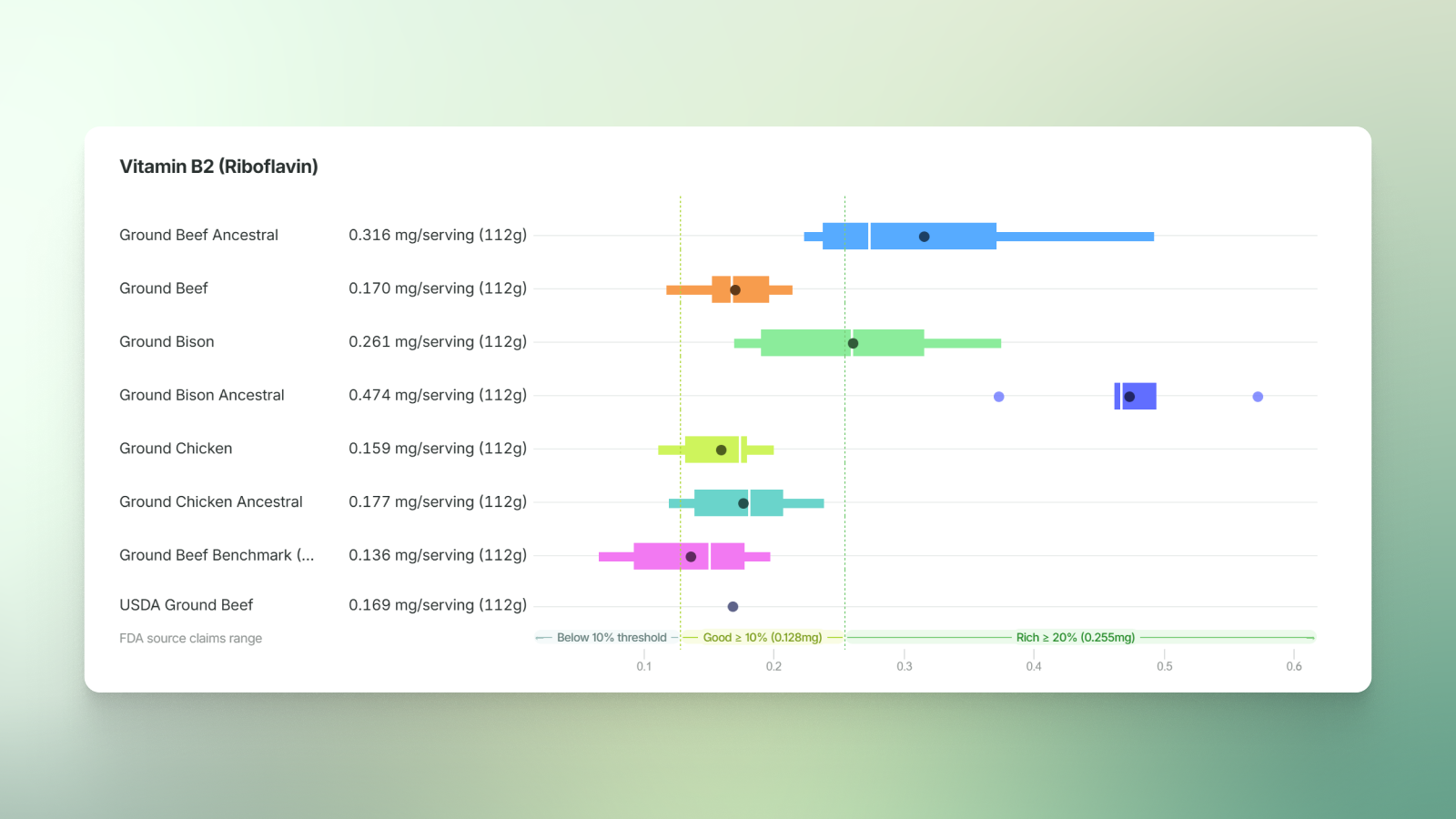
Riboflavin (B2) helps convert food into energy and supports healthy skin and eyes. Pantothenic acid (B5) helps the body process fats and convert food into energy. Both sit below the claims threshold in standard ground beef and cross into "good source" territory in the organ-inclusive blend, roughly doubling to tripling along the way.
Iron, Niacin, and Vitamin B12 Were Already Strong, and Climb Higher Still
Iron, niacin, and vitamin B12 were already claims-eligible in standard ground beef. Blending raises each of them further, but doesn't change which claim tier they land in. Iron is worth calling out specifically: it's a recognized shortfall nutrient, especially for teen girls and women of childbearing age, and beef delivers it in the well-absorbed "heme" form, so a modest, consistent lift here matters even without a tier change.
Zinc and Selenium Don't Change Much With Organ Inclusion
Zinc (already "rich in" at roughly 40% DV) and selenium (roughly 24% DV) don't move meaningfully with organ inclusion; for these, the nutrient-density story belongs to ground beef itself, not to blending.
Force of Nature Puts the Pattern on Shelf
Force of Nature already builds its Ancestral™ Blends line around the same idea this post opens with: organ meat blended back into everyday foods, positioned as a more nutrient-dense way to eat.
"Across human history, organ meats have been prized for their nutrition. Ancestral™ Blends bring that tradition into everyday foods like ground meat, sausages, and meatballs, making it easy to get more nutrient-dense organ meats onto the table.
They start with animals raised on ranches that prioritize healthy animals and healthy land, and independent lab testing helps us see how those practices show up in the final product. We like to call Ancestral™ Blends the easiest health upgrade you'll make.”
— Robby Sansom, CEO, Force of Nature
Their Ground Beef Ancestral™ Blend's full results are published here, and the breadth is the headline: of the nutrients Edacious tested, this blend qualifies as a rich source of seven and a good source of three more. Several of those results are the same nutrients this post has already flagged at the category level. Vitamin A and copper, the two nutrients that move from "not claims-eligible" to "rich in" across the broader dataset, clear that same bar here (35% DV and 38% DV). B2 (Riboflavin) goes a step further than the category pattern: at 24% DV, it lands a full tier higher, "rich in" rather than just "good source." Iron comes in at 14% DV, matching the category-wide blend average almost exactly, and zinc and selenium track the "doesn't move much with organ inclusion" finding from earlier in this post just as closely. Phosphorus is the one genuinely new data point, a nutrient outside the main 327-sample comparison, clearing "good source" on its own at 15% DV.
While this is one brand's results on one formulation, it's a concrete example of how organ inclusion can turn an everyday food into something measurably more nutrient-dense, in a product on the shelf today.
How Organ Blends Cross FDA Nutrient Content Claim Thresholds
Vitamin A and copper both move from "present but not claims-eligible" to a defensible "rich in." Riboflavin and pantothenic acid cross into "good source." Iron, niacin, and B12 were already claims-eligible in standard ground beef; blending raises the numbers but doesn't change the claim tier for those three. That distinction matters: "newly crosses a threshold" and "already there, now higher" are different stories, and treating them as interchangeable overstates what a reformulation actually accomplishes.
Two things worth keeping in mind. First, a large relative jump isn't automatically a big deal on its own. For example, vitamin A's jump looks enormous mostly because the baseline is near zero, which is why we report it as a move to a real, usable amount rather than as a raw multiplier. Second, the spread within blends is wide. Not every blend sample clears every threshold, and a category average can't tell a brand which side of the line its own finished product lands on.
Does Organ Meat Increase Heavy Metals? What Our Testing Shows
One question we hear often from brands considering an organ-inclusive formulation: “Won't heavy metals go up too, since the liver is where an animal concentrates and filters trace elements?” It's a fair concern.
But across the arsenic, cadmium, mercury, and lead results on record for the organ-inclusive and standard samples compared here, nearly every result came back below the limit of quantification. That does not mean heavy metal levels can never be a concern in an organ-inclusive formulation. It means the products we have tested to date have not shown it, and it is exactly the kind of assumption that should be checked with real testing rather than settled by intuition.
Why Product-Level Testing Matters for Nutrient Content Claims
A brand cannot know which side of that gap a reformulation lands on without measuring the finished product, especially in a category like organ-inclusive blends where public comparisons are essentially non-existent. Averages hide meaningful differences, and "ground beef" is a wide enough category that a percentage-point change in formulation can shift where a product lands on nutrient density and on claims eligibility. Verified, product-level testing is what turns that shift from a marketing assumption into a defensible number.
This blog and the content within are based on a locked Edacious dataset of ground-beef results (327 samples: 274 standard ground beef, 53 organ-inclusive blends; results completed February 2025 to July 2026). All values per 4 oz (112 g) serving. Per-nutrient sample sizes noted above.
.png)
.png)

