
Every result Edacious delivers starts as a measurement in our lab. Everything our partners build on that measurement depends on it being accurate. So how does a lab show that its numbers are right?
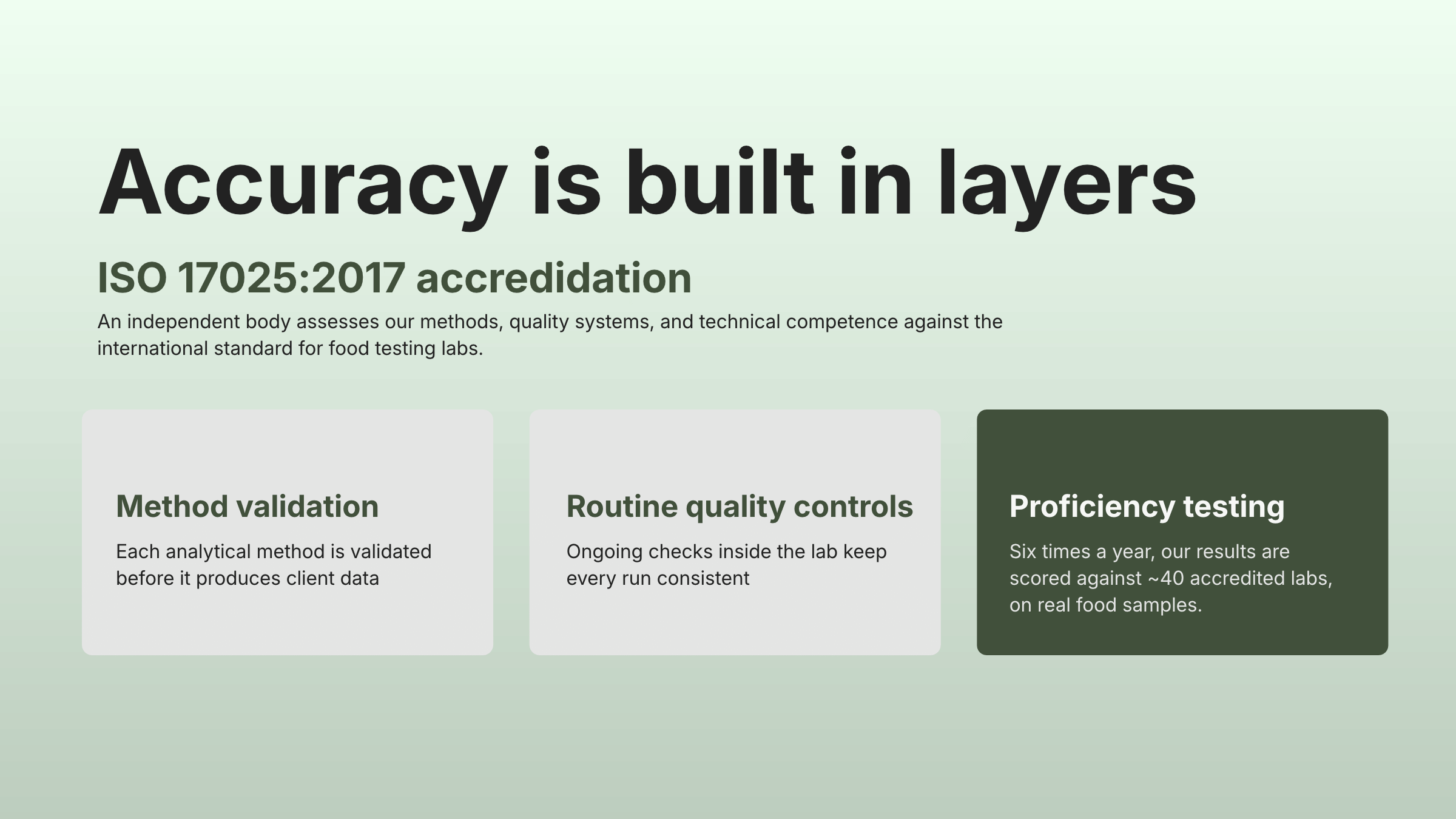
The foundation of that accuracy is our ISO 17025:2017 accreditation. ISO 17025 is the international standard for testing laboratories, and accreditation means an independent body has assessed our lab's methods, quality systems, and technical competence against that standard. For customers, it's the clearest assurance that a lab's results can be trusted.
Accreditation is also an ongoing commitment. Our lab validates its methods, runs routine quality controls, and checks its performance against outside benchmarks. Proficiency testing is one of those checks, and one of the most direct. Every other month, our lab analyzes a food sample alongside accredited labs around the world, and every result we report is scored independently against theirs.
What Is Proficiency Testing for Food Testing Labs?
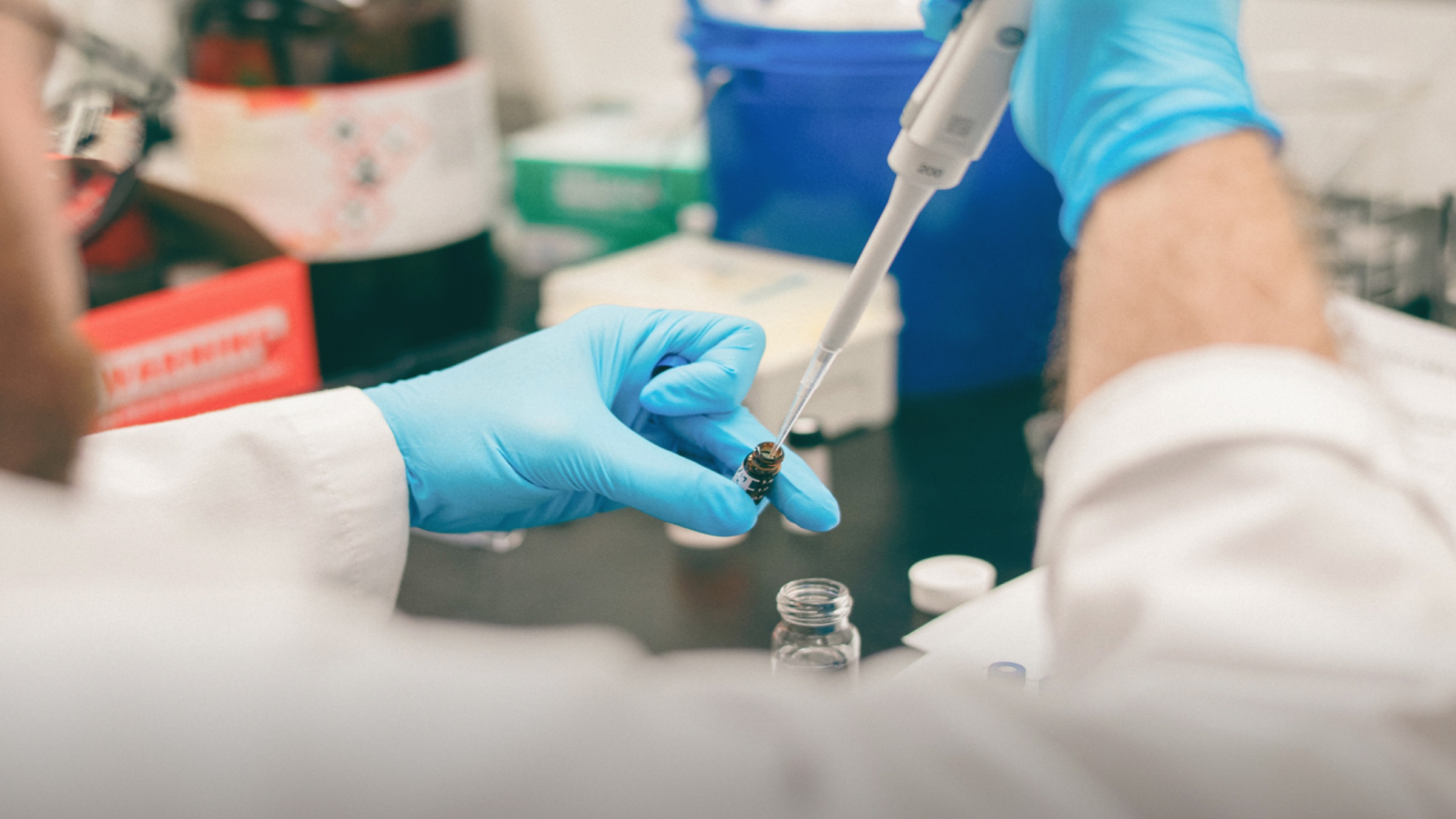
Proficiency testing (PT) is an external check on a lab's performance. A PT provider prepares a single batch of food, sends identical portions to participating labs, and asks each lab to analyze it with its own methods. No lab knows the expected results in advance. Once everyone has reported, the provider compares each lab's results with the group's.
We work with BIPEA, a proficiency testing provider based in France. In a typical round, roughly 40 labs take part alongside us. BIPEA keeps every participant's identity confidential, just as our lab keeps client information confidential. BIPEA sends real food samples with naturally occurring nutrient levels. Real foods are harder to analyze than supplements or capsules, which makes them a more representative test of how our methods perform on the foods our partners send us.
Because every lab receives the same material, proficiency testing answers a direct question: when our lab measures a food, do our results agree with the broader community of accredited labs?
How Proficiency Testing Is Scored: Z-Scores Explained
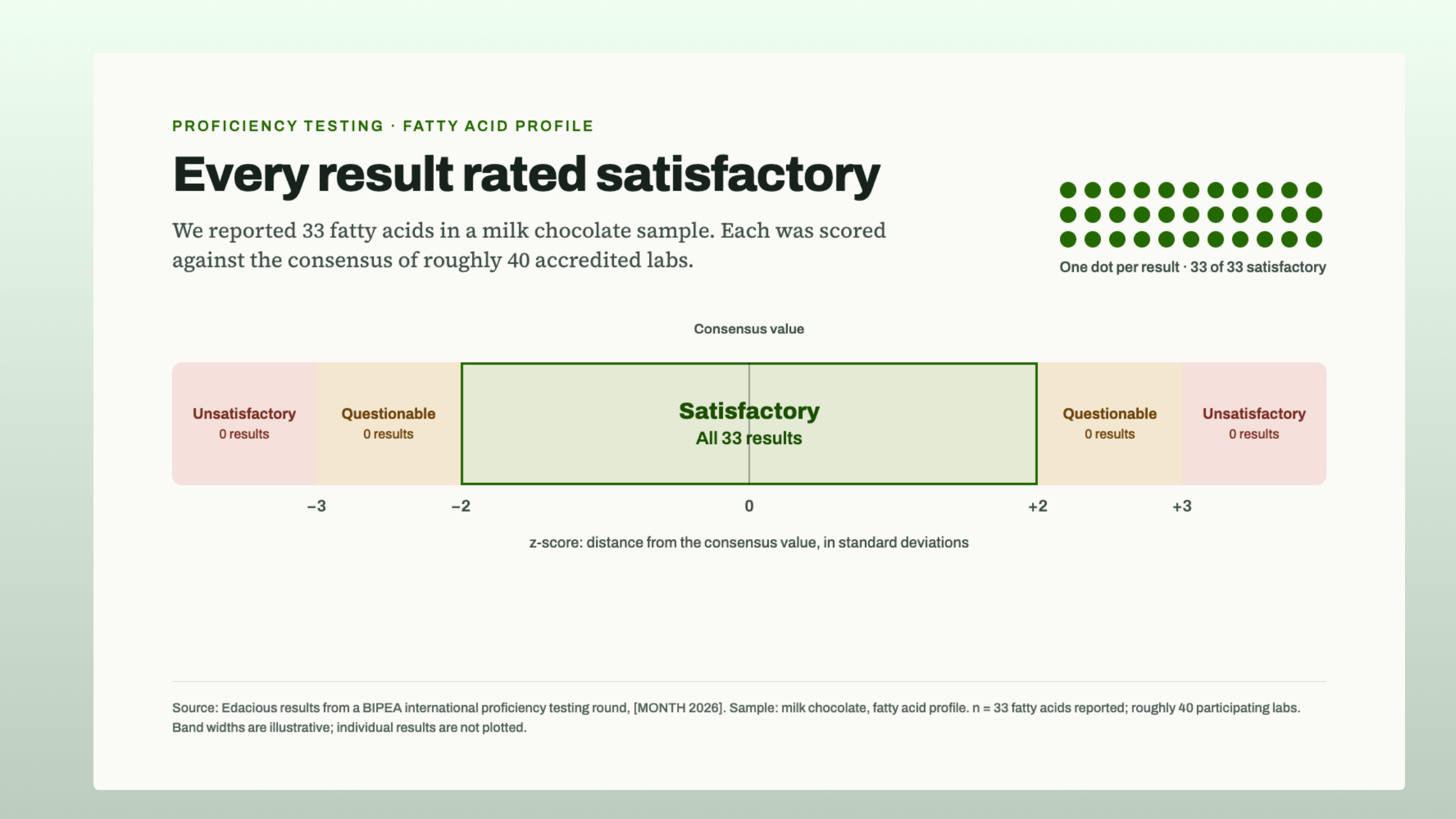
BIPEA scores each result using a z-score, which measures how far a lab's value falls from the consensus value, expressed in standard deviations. A z-score can be positive or negative, depending on whether a result falls above or below the consensus.
A z-score between -2 and +2 is rated satisfactory, the highest rating. Scores between 2 and 3 in either direction are rated questionable, and scores of 3 or more are rated unsatisfactory.
Each analyte in a round is scored separately. For a method that measures dozens of analytes at once, every one of them has to hold up.
Inside Our Proficiency Testing Program
Our lab participates in proficiency testing six times a year. BIPEA rotates through protein-, carbohydrate-, and lipid-based foods over the course of a year, so our methods are tested across very different food compositions. Recent rounds have included mayonnaise, vegetable soup, chicken cordon bleu, cookies, and aged cheese, to name a few.
Our PT schedule runs on a rolling four-year cycle that covers every analytical method we perform. Each year, we focus on a subset of methods, use proficiency testing to identify any issues, and resolve them before moving to the next subset. Over the full cycle, every method is vetted.
ISO 17025 requires accredited labs to maintain a proficiency testing program but leaves the frequency to each lab. We chose a rigorous one: participation every other month, with every method we run covered over a rolling four-year cycle.
Fatty Acid Analysis in Milk Chocolate: Our Latest Results
Our most recent sample was a bar of milk chocolate, analyzed for its fatty acid profile. It's one of the more demanding methods we run.
"Fatty acids" covers a large family of analytes. Some are small and volatile, like butyric acid (C4:0). Others are long and heavy, like lignoceric acid (C24:0). They range from fully saturated to polyunsaturated, like DHA (C22:6), and many exist as isomers: analytes with the same size and composition but different structures, which have to be separated from one another on the instrument. Concentrations in food vary just as widely. In a single analysis, we have to measure analytes present at percent levels alongside analytes present at parts per million.
Milk chocolate adds another challenge. It's a high-fat food, and its fatty acid profile is one of its defining characteristics. The sample has to be diluted precisely, because too much fat overloads the instrument and compromises the data.
Our method measures 48 fatty acids. Of those, 33 overlapped with this PT round, and we reported results for all 33.
Every one of the 33 results was rated satisfactory. None were questionable.
That result matters because of the scale involved. With this many analytes in one analysis, statistical variance alone means even a strong lab can expect a borderline value or two. A clean result across all 33 reflects years of method development by our lab team.
Why Accurate Lab Data Matters for Food Brands
Every Edacious report, benchmark, and claim qualification depends on accurate measurement first. Our ISO 17025 accreditation establishes that our lab meets an international standard for testing. Proficiency testing is one of the ways we continue to prove it, checking our results against labs around the world, across every method we run.
For our partners, that means confidence in the data behind their decisions. When we compare a product with a benchmark, partners can trust that the differences we report come from the food itself. When a brand builds a claim on our results, that claim rests on data that holds up outside our own lab.
Independent checks like this are how we know the data we deliver is accurate, and how our partners can know it too.
If you're evaluating a lab partner, our team is happy to walk through our accreditation, methods, and quality program with you. Get started →