


Walk the rows at Flynn Creek Farm and you’ll notice something immediately: everything feels intentional. The spacing, the cover crops, the way the crew talks about each field as if it has a personality of its own.
Entering their second full growing season, the team had a working hypothesis: that their soil-first practices would produce healthier, better-tasting vegetables. They believed it. But they couldn’t yet measure it.
Like many early-stage regenerative farms, Flynn Creek lacked a clear way to assess nutrient density or compare their produce to retail alternatives. Without data, their belief remained just that — a belief. So, they partnered with Edacious to put it to the test.
Turning a Hunch Into Hard Data
In 2025, Flynn Creek partnered with Edacious to test four of their core crops: salad greens, tomatoes, beets, and carrots. The goal was to take a closer look at what the soil was producing, compare the results to USDA and retail benchmarks, and translate complex nutritional data into something the farm could use for marketing, management, and long-term planning.
The results were unmistakable.
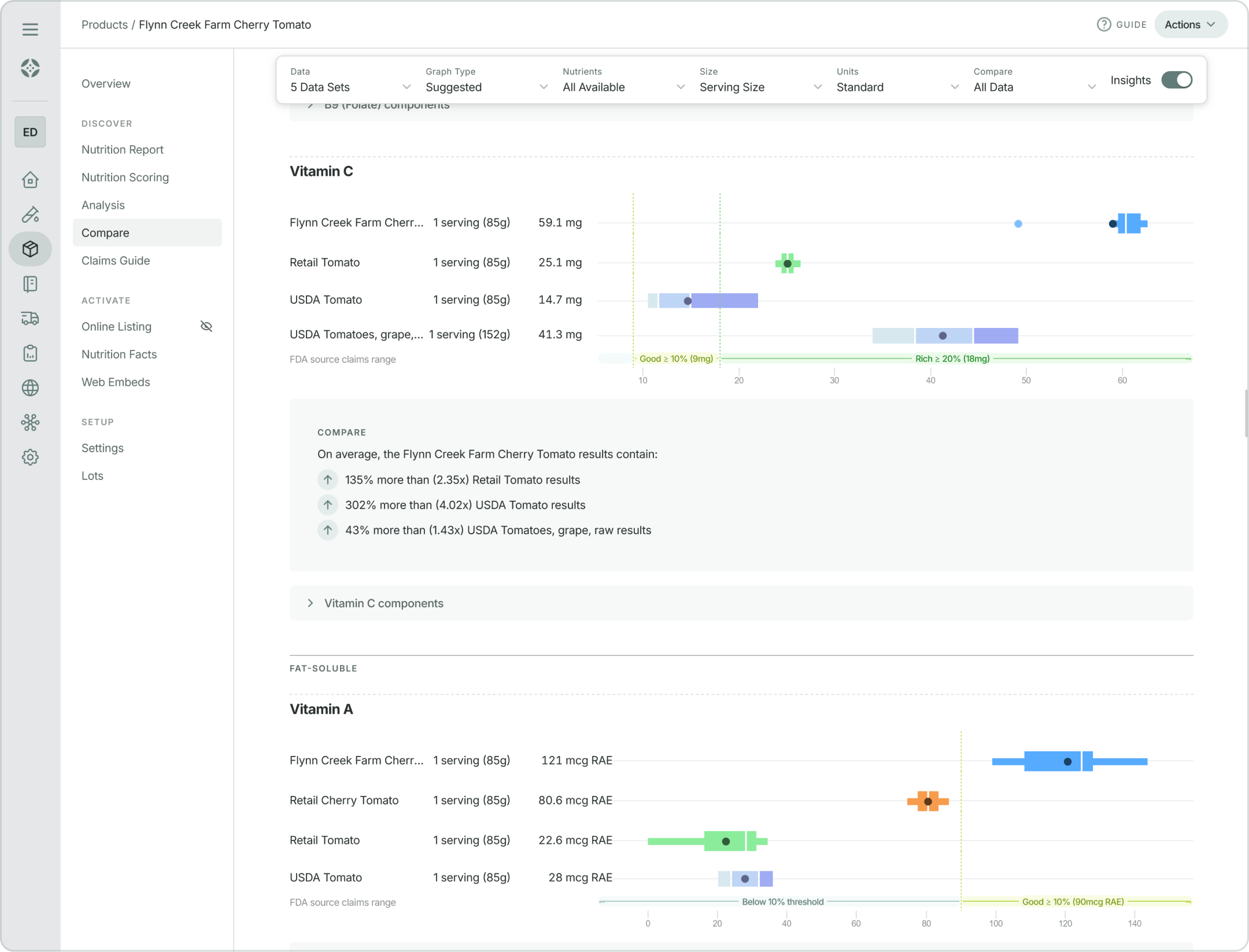
Flynn Creek’s produce consistently outperformed retail comparisons, with many vitamins and minerals measuring 2–4× higher. Salad greens showed elevated B-vitamins and Vitamin C, while tomatoes delivered particularly strong gains, including a 302% increase in Vitamin C and 435% higher Vitamin A.
For a farm still in the early stages of increasing soil organic matter and biological activity, the data offered powerful validation. Their regenerative practices weren’t just philosophical, they were measurable.
Seeing the Full Picture
Beyond validating nutrient strength, the testing also offered a clearer view of the soil itself. A handful of trace indicators — often tied to historical land use or naturally occurring background levels — gave Flynn Creek useful context for long-term monitoring and continued soil improvement.
Edacious helped interpret these insights, highlighting not only where the crops excelled but what the soil might need next. As committed land stewards, the team welcomed the fuller picture. The results provided both affirmation and direction. Flynn Creek now has a measurable starting point from which to track how soil health and nutrient density evolve together.
A New Layer of Transparency
In an era where origin claims, growing methods, and sustainability are everywhere, Flynn Creek now has something many farms don’t: proof.
Scientific, independent, data-backed proof of what their soil can do, and a clearer path for sharing it.
As they explore ways to share these findings publicly, Flynn Creek will be able to offer customers a level of transparency that’s rare in produce—and powerful in a crowded marketplace.
The Soil Always Has a Story.
What began as a simple question—“Is our produce truly more nutrient-dense?”—turned into something much larger. The testing validated their strengths, pointed toward new opportunities in the field, and helped shape a clearer, more compelling way to talk about the food they grow.
For Flynn Creek, the work was a reminder of something they’ve always known intuitively: healthy soil speaks. With the right tools and the right partnership, you can hear it clearly.
And when you listen closely, it doesn’t just change your understanding of the land, it changes how you share your story with the world.
.png)
.jpg)

