
When evaluating food testing providers, ISO 17025 accreditation often comes up as a differentiator. But what does it tell you about a testing laboratory and why does it matter?
At its core, ISO 17025 is the international standard to determine whether a laboratory is competent to perform analytical tests. It establishes requirements for quality, competence, and consistent operations. Labs that achieve this accreditation can produce reliable, repeatable, and defensible data.
Importantly, not all food testing is conducted in facilities with international accreditation. Some providers operate as research laboratories, where the primary goal is exploration and discovery rather than generating data designed for regulatory or commercial use.
Understanding this difference matters, especially if the goal of testing is to inform labeling, marketing claims, or sourcing decisions.
What ISO 17025 Accreditation Requires for Food Testing Labs
Accreditation is not automatic. It requires an independent accreditation body to verify that a laboratory demonstrates competence to perform specific tests under strict operational standards. Accreditation must be maintained through regular auditing and applies to a defined scope of tests, not necessarily every analysis a lab performs.
To achieve ISO 17025 accreditation for specific tests, labs must demonstrate:
- Validated methods. Testing procedures are scientifically sound and appropriate for the food matrix being analyzed.
- Calibration and traceability. Instruments are maintained, equipment performance is verified, and all measurement data traceable to external, accredited sources.
- Quality controls. Each analytical run includes internal standards and controls to ensure accuracy.
- Documented procedures. Every step is recorded and traceable, creating a transparent chain of evidence.
- Technical competence. Staff are trained and qualified to perform the specific analyses they conduct.
- Regular audits. Independent assessors review processes, documentation, and results to confirm ongoing compliance.
This structure ensures that results are repeatable and defensible over time. When testing is conducted under ISO 17025 accreditation, the lab has demonstrated competence to perform that specific analysis according to validated methods. Accredited data can withstand regulatory scrutiny and be recognized by partners, certifiers, and industry organizations.
Research Labs vs. ISO 17025 Accredited Labs: Key Differences
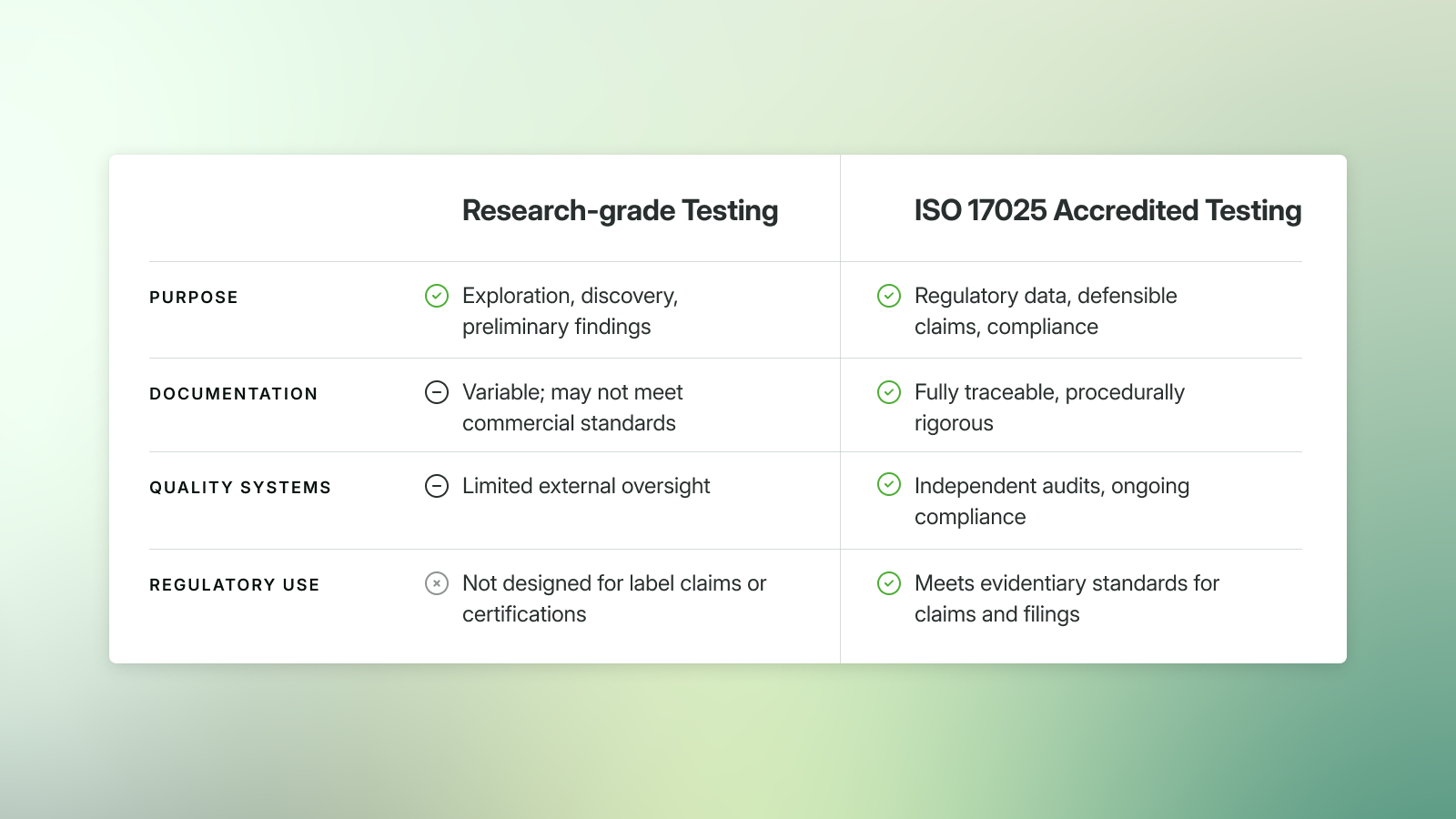
Research laboratories play a role in advancing nutritional science. The goal of research-grade testing is often to generate preliminary findings or contribute to academic knowledge, not for routine daily use or to produce data for product labeling, regulatory compliance, or commercial claims.
Some key distinctions:
- Documentation requirements. Research labs may not maintain the same level of procedural documentation, training, or traceability as required under ISO 17025.
- Quality management systems. Accredited labs operate under structured quality systems with routine audits. Research labs may not be subject to the same oversight.
- Method validation. ISO 17025 requires that methods be validated for accuracy, precision, and reproducibility. Research protocols are not required to not undergo the same validation procedure.
- Regulatory recognition. Accredited lab data is designed to meet the evidentiary standards expected by regulatory bodies and third-party certifiers.
This doesn't mean research-grade data is inherently incorrect. Rather, research data is generated under a different framework, one that may not meet the requirements for defensible claims or compliance documentation, and that distinction matters.
Why This Matters for Food Brands and Producers
If nutrition data will be used to support a label claim, develop a nutrition facts panel, marketing message, or sourcing standard, the accreditation of that data matters.
ISO 17025 accreditation assures that the lab has demonstrated competence to perform the test, that methods are validated, and that results are repeatable and defensible.
- Quality controls and robust, validated methods reduce the risk of error or variability.
- Independent labs using the same method should produce comparable outcomes.
- If questioned by a regulator, retailer, or certification body, the data can be traced back through a documented chain of evidence.
A protein claim based on unaccredited testing may satisfy initial review, but if challenged later, the lack of procedural documentation can put the claim at risk. Without accreditation, even well-intentioned testing may lack the procedural rigor required to support claims that will be scrutinized over time. This can result in waisted time, money, and trust for companies investing in food data.
How to Evaluate Food Testing Providers
When comparing food testing options, consider asking:
What is the intended use of the data? If the results will inform regulatory filings, certifications, or marketing claims, accreditation is essential. If the goal is exploratory research, a research lab may be appropriate.
Is the lab ISO 17025 accredited for the specific analyses you need? Accreditation applies to a defined scope of tests and not all labs hold accreditation for every test they offer. Confirm that the lab's scope of accreditation includes the specific analytes and food matrices you need tested.
What quality controls are in place? Ask about internal standards, equipment calibration schedules, and documentation practices.
Can the lab provide method details and validation data? Transparency about methodology is a signal of rigor. In addition to your analytical results, laboratories can make available, upon request, the analytical measurement uncertainty associated with your values.
Does the provider offer interpretation alongside the numbers? Verification produces trustworthy data, but quality interpretation makes that data usable.
Verification Is the Foundation
ISO/IEC 17025:2017 accreditation doesn't answer every question about food quality, but it does establish the conditions under which reliable measurement can occur.
We believe defensible claims require defensible methodology, and clarity begins with measurement you can trust. At Edacious, our food lab holds ISO 17025 accreditation for a comprehensive scope of nutritional analyses. Our services are built on this foundation, and we pair verified testing with contextual interpretation so nutrition data becomes insight, not just numbers on a page.
Download our Guide: https://www.edacious.com/download/why-iso-accreditation-matters-guide
Ready to work with a lab built for both verification and understanding?
Explore our food lab services: www.edacious.com/food-lab
Schedule a demo: www.edacious.com/get-started
.png)